
News
〰️
News 〰️

The media absence was not accidental:
Despite the scale of the event and the urgency of the issues, mainstream media outlets largely ignored it. No front-page coverage. No prime-time interviews. No sustained reporting on the solutions women leaders are building. This erasure is part of a broader pattern:
Women’s leadership is treated as a niche topic.
Feminist political economic analysis is sidelined.
Global majority women’s expertise is rarely platformed unless framed as crisis, rather than strategy.
The result is a distorted public narrative in which women’s rights and gender justice appear marginal, even as movements are generating some of the most innovative thinking on financing, governance, and democracy worldwide.
Finally, a spotlight on alternative financing:
Across multiple panels, roundtables, and movement-led sessions, one theme kept resurfacing: traditional funding models are failing feminist and women’s rights organisations, especially those led by young women, LGBTQI+ activists, rural women, domestic workers, and frontline organisers. Thankfully, the discussions went far beyond the usual calls for “more funding”. Instead they interrogated:
What it would look like to shift true power, not just resources, by ensuring women leaders shape priorities rather than adapting to donor agendas?
How can the movements and organisations leverage innovative finance mechanisms such as pooled feminist funds, solidarity-based lending, diaspora-driven giving, and community-controlled endowments?
Could fiscal hosting become a power-building tool, enabling grassroots groups to access funding without being forced into premature formalisation?
How can we convince funders to move to long-term, movement-sustaining capital, not short project cycles that exhaust organisations and distort their missions.
Accountability must be in both directions i.e. not only from grantees to donors, but from donors to movements.
Speakers from Africa, Latin America, the Pacific, and Europe echoed the same message: the current funding system is collapsing, and feminist movements are paying the price. Over the last five years, funding for women’s rights organisations has dropped dramatically with some estimates suggesting an overall loss of around 60% compared to 2020. These cuts are even more harmful given that authoritarianism, backlash, and gender-based violence is intensifying. Women Deliver 2026 was one of the few global spaces where these truths were spoken plainly.
What Women Deliver 2026 showed the world, even if the world wasn’t watching:
Inside the conference halls, the energy was unmistakable. Women are not waiting for permission to redesign the funding ecosystem. They are already doing it by building cross-border alliances, designing new financial instruments, and insisting that money must follow movements, not the other way around.
Women Deliver 2026 was a reminder that feminist movements are not only demanding resources; they are reimagining the architecture of power. The tragedy is that mainstream media missed the story. The opportunity is that movements will tell the story themselves.
Women Deliver 2026, Narm/Melbourne
Why Alternative Feminist Financing Can’t Wait .... and Why the Media Missed the Story
Last month, the sixth Women Deliver conference in Melbourne brought together more than 6,000 women leaders, organisers, activists, funders, and movement-builders from around the world on a scale and with a diversity of participants rarely seen in any global convening. Yet if you relied on mainstream media, you would barely know it happened. The world’s largest gathering of feminist leadership was met with near-total media silence. That silence matters, because the conversations happening inside those rooms were not symbolic. Among other consequential topics, discussion included strategies for the future of feminist organising, specifically the financing models that will determine whether women’s rights organisations and movements are resourced to survive the next decade.

Why is it important to fund movements and not individual organisations?
In order for movements to thrive, we need to fund the ecosystems in which they work. It’s not enough to fund an individual organization. Rather, we need to fund the plurality of organisations and activists and perhaps most importantly, we need to fund the spaces, processes, and mechanisms through which they can come together to build collective strategies, mobilise critical mass and withstand authoritarian backlash.
A good example of this was the approach that the Issues Affecting Women programme at Oak Foundation took towards supported the domestic violence ecosystem in Moldova. You can read more about that work here. When we started our grantmaking in Moldova, the sector was very fractured and there was very little collaboration or trust among the different actors. At the same time, rates of domestic violence were very high and normalised. Oak provided funding to individual organisations and importantly, also supported the creation of a new network with one condition. All organisations that shared the same mission to eradicate domestic violence in Moldova should be welcome. Through patience, hard work and thoughtful facilitation, the network succeeded in building trust among the different actors such that in 2021, their collective efforts helped lead to the Moldovan Parliament ratifying the Istanbul Convention on preventing and combating violence against women and domestic violence. This was a significant achievement that seemed virtually impossible a decade before.
Not all parts of the movement do the same thing. But they need to work together – like the instruments in an orchestra or a jazz band.
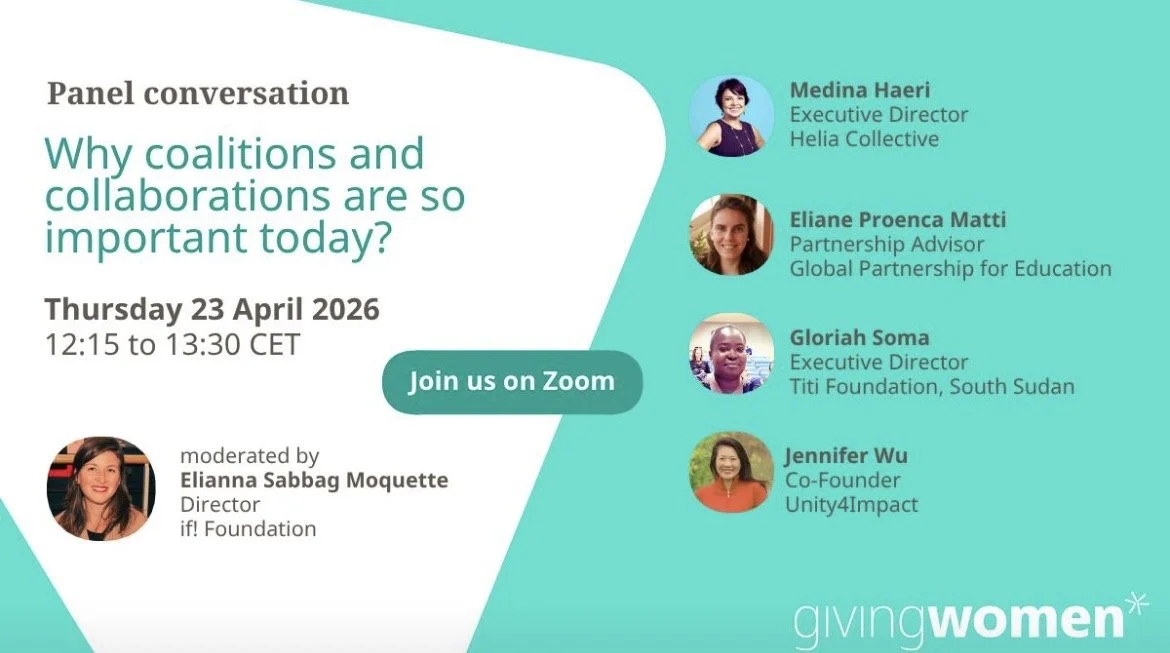
On Thursday, 23 April, Helia’s Executive Director, Medina Haeri spoke on a panel organized by Giving Women – as a women’s membership association and a growing community of Action Philanthropists dedicated to improving the lives of women and girls worldwide.
The panel was focused on the importance of collaborations and coalitions in helping respond to an increasingly uncertain and unpredictable world where business as usual is no longer effective. The panelists discussed the importance of approaches that are grounded in partnership and mechanisms that ensure that money and decisions are being directed to the most relevant and pressing needs.
How does collaboration relate to security and mutual care systems?
Organisations working in regressive contexts face a lot of threats. That could mean being fined or imprisoned, being stripped of their legal registration, or having their bank accounts frozen. Activists often face online harassment, or may be physically attacked or even killed.
When organisations and activists feel alone, they are more vulnerable to attack and the attacks are far more likely to succeed in convincing them to stop their social justice work.
However, when organisations and activists are connected with other actors in their ecosystem or movement, they have far greater resilience and can build systems of collective security and mutual care. This can mean sharing intelligence, conducting joint risk analysis and integrating a mutual care framework into their security protocols.
I have seen this work very effectively in Mesoamerica, which is one of the most dangerous regions in the world to do human rights work. These risks are compounded further for women human rights defenders.
Sixteen years ago, a group of local feminist organisations in this region decided to come together and create a network to document abuses, advocate for improved state responses, and build resilience and protection strategies for women human rights defenders in this region. The result was the formation of the Mesoamerican Initiative of Women Human Rights Defenders (IM Defensoras) which works across 5 countries and has supported thousands of defenders through its accompaniment, advocacy and collective care efforts.
One of their most significant contributions has been the creation of their Feminist Holistic Protection framework, which they describe as a pact that they make among themselves to protect each other from all forms of violence. What this means in practice is that instead of one defender who facing violence feeling alone and ostracised, she is supported by a broad network of defenders that help her develop security strategies, provide psychosocial support and even help her to relocate to a safe house or a new country if she needs.
An integral component of this approach is understanding the importance of rest. IM Defensoras has built two healing and recovery centres in the region that welcome defenders and their families to have a break from their human rights work and focus on their wellbeing. Through this approach, IM Defensoras has supported thousands of defenders and sustained their movements. It is a model for other human rights movements around the world and a testament to the importance of centring care as a critical component of security protocols.
Watch

Why Collaboration Matters
This is a difficult moment for women’s organisations and equally harder for women in leadership and political roles. Women leaders are often supported into power as part of the patriarchal systems and structures causing harm, they are invited into politics symbolically while the real power is centralised and rights are rolled back. On the other hand, the few feminist leaders who finally access power are vilified or blamed for “divisive” gender agendas. Recent funding towards gender inclusion has been rebranded into safe language that foregrounds entrepreneurship and inclusion, while feminist organising and movement-building, that are supporting political and social change are deliberately defunded. Simultaneously, women activists and leaders face online abuse, physical threats, and digital surveillance, especially when they challenge extractive industries, land grabs, or political elites or run for office. These risks are real, and they are global. But alongside them are important opportunities.
The move to “localisation” is about cost effectiveness for funders but it is also an opportunity for women. As large aid programmes shrink, donors are looking for trusted local partners. Women’s organisations and leaders have long done extraordinary work with very little funding. The current crisis creates the circumstances to redirect resources toward them. The humanitarian and development sector shift toward localisation means women’s groups and leaders are the partners who already know the terrain, context and solutions.
Resourcing community-led design of leadership programmes, equitable mentorship, and intersectional political organising are not add-ons. They are the conditions for real development, growth and political participation. And they are the only way to ensure that the next generation of women leaders does not inherit the same barriers we have spent decades trying to dismantle.
New forms of organising are incubators for positive change. Young women are organising through digital platforms, arts and culture, and mutual aid networks. Funders and institutions are often slow to get behind these opportunities because it is outside their comfort zone. But these are the spaces where future political leadership is nurtured.
Intersectional alliances recognise that women rarelyexperience a single issue in isolation. Political participation is intertwined with climate justice, economic justice, land rights, and health. Alliances across movements are no longer optional; they are the strategy. Women fighting for land, against mining abuses, or for healthcare are doing deeply political work, even if they are not in elected positions of authority.
So philanthropy is at a cross roads when it comes to building a strong cadre of women leaders. Many philanthropists talk about wanting to stay out of politics. But women and women’s organisations understand that everything they work towards is political. The choice is clear; will funders retreat to “safe” programming at precisely the moment that political courage is needed or will they resource women on the frontlines of change?

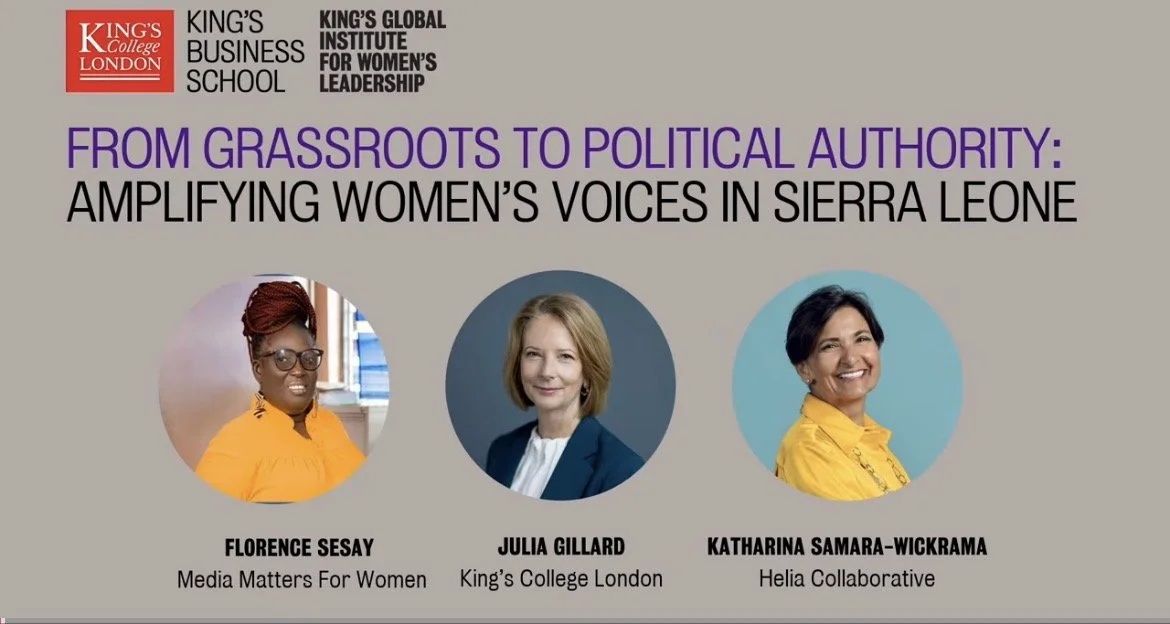
On 9 March 2026, Helia Collaborative co-founder Katharina spoke on a panel at King’s College focused on building women’s political power and rethinking how we resource feminist agendas. The panel was moderated by former Australian Prime Minister Julia Gillard and featured new research by Florence Sesay, Executive Director of Media Matters for Women Sierra Leone and a Changemaker at the Global Institute for Women’s Leadership (GIWL).
The discussion was a blue print for how philanthropy and feminist funding needs to change and adapt to meet the current moment. The panellists called for bold and courageous new thinking about how to resource feminist movements to shape the agenda and build and sustain a political sea change.
The full recording of the panel is available here.
The numbers are stark. According to the Human Rights Funders Network, unprecedented global aid cuts are wiping out tens of billions of dollars from civil society. UN Women reports a 66% decline in funding to women's organisations over the last four years alone. In some regions, nearly half of women-led organisations expect to shut down within six months.
The question we should be asking is no longer how do we fund women's organisations? It's how do we shift power so that women leaders themselves shape the agenda? Those are very different questions — and confusing them is precisely how well-intentioned philanthropy ends up reproducing the hierarchies it claims to dismantle.
Watch
Re-Imagining Feminist Funding as power redistribution - A conversation with Katharina Samara-Wickrama
We need to move beyond traditional feminist funding
For years, feminist movements have pushed funders toward three essential practices: core funding instead of narrow project grants, multi-year commitments that reflect the long arc of social change, and flexible funding that allows leaders to adapt to political realities. But even with these hard won advances in funding models, funders urgently need to go much further.
Resources must reach the “last mile” where organising for change is happening. While limited, funding flows have traditionally favoured NGOs concentrated in capital cities. Meanwhile, the groups driving social change far from the centres of power such as, rural women’s collectives, informal networks, young feminist organisers, disabled women’s groups, LGBTQI+ activists, market women, and domestic workers, remain under-resourced. Funders argue that resourcing small frontline women’s groups is complicated. However, reliable mechanisms for overcoming those challenges are already available. For decades, women’s funds have shown us how to successfully resource grass roots groups. Organisations like the DRC Women’s Fund, Doria Feminist Fund in the Middle East, and the Ukrainian Women’s Fund understand their communities’ contexts, the risks they face and the opportunities and capacities local groups can leverage, in ways that distant donors do not. They know where resources are needed most. So they are able to get money to the right groups, not just the visible ones.
Funders need to resource the ecosystems, not just individual organisations. Movements succeed when organisations and networks connect expertise, strategies and goals. Leadership programmes for women, legal advocates, health workers, youth education, organisations working with men and boys; when these groups collaborate, the impact multiplies. Women have long understood that connection is their superpower. But collaboration needs time, care, and resources. It requires funding for the invisible work: caregiving, movement-building, security, healing, political education, and the time to organise. When collectives of organisations are adequately resourced and their collaboration is funded, feminist alchemy happens.
Decision-making power must shift closer to the communities that are doing the work. When funding decisions remain far from the communities they affect, power does too. Decision-making needs to move closer to where the work happens. Local women leaders need to be included on donor advisory councils, funding review panels, and help co-design funding criteria. They should help define what success looks like. The role of funders is to resource and not to direct.
Donors need to rethink accountability. Traditional monitoring and evaluation often functions as a mechanism of control. Multiple assessments have shown that reporting and compliance obligations absorb a disproportionate amount of time for small organisations, sometimes taking up half of their available staff capacity. So accessing resources can mean organisations spend much of their time reporting, rather than doing the critical urgent work needed in their communities. We need to remodel accountability from a time consuming policing process. We must shift from traditional monitoring, evaluation and learning model to valuing mutual accountability through learning, celebrating success and communicating learning and impact. The harder questions are the most important ones: Are funders accountable to the movements they claim to support? Do women leaders have channels to critique donors? Can they say “no” to unreasonable demands?
Funders must intentionally share the risks. Women activists already take enormous personal risks. On 2 March 2026 Yanar Mohammed, one of Iraq’s most prominent feminist and human rights defenders was murdered. Her decades of work, including founding the Organization of Women’s Freedom in Iraq (OWFI), establishing shelters, and advocating for women’s rights, made her a central figure in the struggle for gender equality in the region. While donors cannot reduce the physical danger they face, they can at least ensure that activists are not carrying the financial and administrative risks as well. When funding becomes fuel for women’s political agendas, rather than a tool to discipline them into donor log frames, then power begins to shift.
The global backlash is an opportunity to push for greater women’s political participation.
Beyond funding: feminist mentorship is transformative when it is intentional, equitable, and honest about power.
While resourcing is important to enable women’s organisations to bring about change in their communities; ensuring more women take up decision making positions is the game changer. From West Africa to Europe to South Asia, the same lesson keeps resurfacing: if women aren’t shaping the leadership pipeline for their communities, we’re not doing community-led work. We’re just rebranding top-down politics.
When women define political participation for themselves, the picture is far more diverse than donor metrics suggest. In some contexts, participation means running for office. In others, it means influencing traditional authorities, becoming village chiefs, controlling land rights, or shaping local budgets. These are all political acts — even if they don’t fit neatly into a parliamentary quota. Funding must follow their definition of power rather than a narrow “increase the number of women in parliament” target. When donors cling to a single metric they can miss the real sites of authority where women are already negotiating power every day.
This is the politics of opportunity. Transformative women’s leadership programmes offer strong mentorship, accompaniment and partnership. But who gets mentored and is never invited to those opportunities? Most leadership programmes still select the same profile: urban, English-speaking, (or at least speakers of another colonial language), already visible women. It’s efficient, it photographs well, and it reproduces the very hierarchies it claims to challenge.Power hides in the smallest administrative decisions: who receives scholarships, who gets invited to trainings, who is encouraged to run for office, who is quietly told “it’s not your turn.” These decisions shape political ecosystems long before a ballot is cast. When donors and NGOs keep selecting “safe” women — the ones who already fit the mould — they are not shifting power. They are simply diversifying the hierarchy without transforming it.
A feminist community-led approach to mentoring starts with a different question: who is never in the room? Rural women, young women, women with disabilities, women working in informal economies or women who are politically active but not institutionally recognised. When these women are not helping to design the mentorship programmes, then the programmes are not about leadership: they are about gatekeeping.
Good mentorship is relational, not extractive. It is not about polishing young women or the unusual suspects into donor-friendly products. It is about listening to communities and women leaders (both formal and informal), affirming political insight, and recognising that their leadership qualities already exist and do not need to be manufactured. If communities aren’t shaping the leadership pipeline, then women’s political participation becomes a performance rather than a transformation. Real power shifts require donors and institutions to let go of their favourite candidates, and all of us to recognise that political participation is not a single pathway, instead it is a landscape of power, shaped locally and lived daily.
Transformative mentorship is honest about power and risk. Women entering public life face harassment, smear campaigns, party politics and burnout. Effective mentorship prepares women to navigate these realities and to transform them.
By way of an example close to (my) home, in Switzerland women were finally given the vote at the federal level in 1971. By 2018, there had been more men in parliament who were named Hans, than women elected representatives. After a concerted campaign by local women’s organisations to have more women elected to the Swiss federal assembly, the numbers increased to an impressive 42% in 2019. But, even when women do enter formal politics, the environment often pushes them back out. By the following election cycle many of those women parliamentarians decided not to run again, citing misogyny and sexist treatment as disincentives. From Europe to Latin America to Africa, women talk about the same reasons for stepping away: hostility, harassment, underfunding, and the emotional labour of navigating institutions that were never designed for them. Mentorship for leadership is not a once and done offering. Women who make it to decision taking roles, need ongoing solidarity and resourcing to balance their exclusion from men’s informal power networks. Representation without that support becomes an exit.
Sponsorship is the turbocharged mentorship. Skills matter. It is important to transfer budgeting, negotiation, and media engagement skills to women taking on leadership roles. But sponsorship goes further. It means sharing platforms, recommending candidates, and opening doors. It also means stepping back to offer young women opportunities to step up.
Mentoring is an intersectional and intergenerational endeavour. Older leaders must expand the circle of power, not replicate themselves. That means actively including younger women, rural women, queer women, and women with disabilities. Good mentorship doesn’t create replicas, it expands the circle of power.
At its core, feminist mentorship is about ensuring the next generation of feminist leaders has the resources, networks and practical support so they do not find themselves fighting the same battles alone.
The Criterion Institute Podcast -
Joy Anderson
A conversation with Joy Anderson, Executive Director of Criterion Institute and Helia Collaborative’s Medina Haeri and Katharina Samara-Wickrama. Together, they explore the parallels between funding social movements and financing market formation companies. Drawing on their decades of experience supporting feminist movement building, Medina and Katharina emphasise the key strategies for sustaining and strengthening social movements: patient, long-term investments; flexible core support rather than short-term project funding; a commitment to relationship-building & collective strategies; and centring the wisdom and lived experiences of frontline activists and leaders. The conversation highlights the importance of laying the groundwork so that movements are ready to act when the moment for change emerges. They also discuss the pitfalls of siloed thinking and why it’s essential to build intersectional strategies.
Joy then connects these insights to the logic of market formation where organisations build demand for something that doesn’t yet exist. This requires long time horizons, experimentation, narrative shaping and capital that tolerates uncertainty. The episode frames this moment as a turning point, with feminist movements beginning to engage more intentionally with innovative finance. Through the Helia Collaborative-Criterion Institute partnership, activists and finance practitioners are learning to speak each other’s language and co-create more resilient, systems-level approaches to financing long-term change.
Listen to